Spring DIY: 4 ways to uniquely transform your T-shirts

Yay. It’s spring. So…ya…but it’s still cold here in Toronto. *sigh. In anticipation of warmer days, I wanted to keep busy with a few t-shirt DIY’s to get me through the last of the cold gloomy winter, as these days summer only feels far away…but it’s coming! And a great summer basic is the T-Shirt, and knowing that distressed cut up tees are still in, why buy when I can DIY? What I love about transforming these clothings is that it’s super easy, no sewing and wearing them just has got a crafty cool, edgy vibe to them. And when I saw Forever 21 recently had a buy 1 get 1 free sale on all sale items, I wanted to take advantage. Buying really cheap sale clothes to cut up makes sense, since the sale stuff are often pretty boring, they are left over stock after all…and asking for transformation via distressing/cutting! Here are the 4 shirts/shifts that I bought from there and will be cutting up:

My “buy 1 get 1” haul from Forever 21. Let’s start cutting and distressing!
  1. Long Beige T-shirt dress with cuffed sleeves:

For this DIY, I wanted to use this shirt as a sleep shirt, long and comfy, no shorts or pants needed to lounge in around the house! But with the thick cuffed sleeves it was not that comfy, or cool looking. So first I cut out the cuffs, for an unfinished sleeve look, and then, cut vertical slits 1 cm wide in the front upper portion and got this:

I like it a lot more now. It’s airy with the slits and so comfy to sleep in. Long enough to wear without sleep pants and not be scandalous!

2. Black tank dress with lace trim:

This dress had all kinds of wrong things going on. It was a thick stiff cotton shift material, the lace trim was too long and not delicate, and the way it hung on me originally was just not flattering. After cutting it up, and doing a “bow tie” tee cut up on the the back, I liked the way it hung a lot more, and it looks more like a party dress now, don’t you think?

“Bow tie” cut up at the back consists of two horizontal cuts and then cinching the material together with another frabric. Super easy and shows off the back…

3. Plain White tee with Pink Trim

I loved the open neck line and soft material of this tee even before I DIYed it. But this tee was still a bit on the boring side, and the big side. I figured that a back weave and side weavings might make it smaller if not more interesting. If you really like this look, it’s easy to find instructions on line on how to do it. It’s actually as easy as braiding hair.

I thought the back/side view of this tee was more interesting, but I did keep the pink collar v-neck trim more visible from the front.

4. Super plain blue pocket tee:

So this t-shirt reminded me of a shirt that an artist/painter might wear in her studio. Loose, flowy, and distressed beyond recognition. But as a new tee, thisĀ  shirt wasn’t going to tell that story. So, after sandpapering holes, cutting holes and just destroying the colour of the shirt with bleach, I got a more raggedy worn-in look. Now the shirt tells the story that I might be a struggling artist and this shirt has been destroyed since I use it for art making and everything else the imagination will allow. Kind of cool…
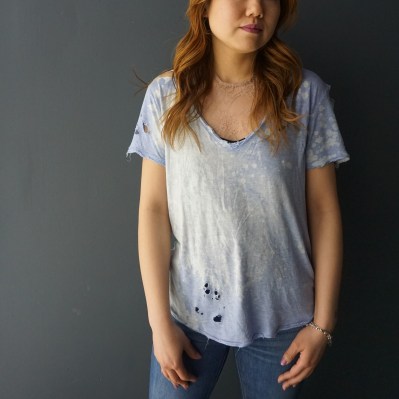
Faded, and with tons of holes, this shirt is just asking to be replaced…but loving that worn in, and careless look.

So after 4 T-shirt transformations, I’m not sure which is my favorite look. Do you have a favorite? Just a note about why I didn’t post instructions on how to do these looks; I wanted this article to be more about being inspired to transform your own clothes in easy effortless ways, but not as a tutorial. But I learned all these techniques online via articles and youtube, so just type in “DIY shirt cut up” and you’ll find all you need to do this too! And other tutorials would probably explain it better than me anyways. Happy Spring DIY-ing!
Why the hesitation to use natural/food grade ingredients in cosmetics?

I never really thought of this before. It’s kind of logical to me. In a battle of best cosmetic ingredients between natural and chemical, natural is just better. If I can eat something, like coconut oil, and then also use it on my hair to moisturize, that’s a win win situation…I have always thought that if it is safe to go into our bodies, it is safe to put on our bodies…but I recently found out not everyone thinks this way…There is a point of view that cosmetics should remain a chemical science, and that putting food on ourselves is just well, kinda dirty. Where did I get this idea from? A man working at a hair supply shop told me this, when I mentioned I used a bit of coconut oil for my dry ends. He said the problem with food grade is that it mixes with microbes and such on our bodies and can easily become rancid and/dirty.

Hmm…Dirty? I never realized this point of view before, and while I think the shop guy might be right to some degree, I still think it’s an exaggeration at best. The outsides of our bodies can take a bit of dirt and microbes. Our own bodily oils are teaming with loads of bacteria and such, it’s all over us…adding food grade ingredients does not necessarily add to the microbial community…maybe it would if we never showered…but the average person in North America probably showers at least once a day; not enough time for coconut oil or any food grade oil to become rancid, and thus dangerous to our health. Advocating for chemicals and chemical preservatives to remain the standard for quality hair care, is a bit unfounded. Many of the chemicals in cosmetics are known to be drying, irritating to the skin, cause allergic reactions, and even have traces amounts of carcinogens. Yikes.

The trend to go natural is so strong actually, that many big cosmo companies now say they have squeezed natural ingredients into their formula. I’ve seen so many times the advertising and labeling of big brand products claiming to use honey, botanicals, fruits, natural oils and butters. The ironic thing is the natural inclusions are often very denatured/altered and it’s a very minute amount that’s used. Why moisturize with a vat of silicones and trace amounts of cocoa butter, if cocoa butter is the actual desirable ingredient? I have to toot my own horn when I say I make a solid lotion at Dream E that is a third made of cocoa butter and all natural other ingredients, except for a small amount of fragrances. But 95% natural is better than 1% natural any day in my opinion.

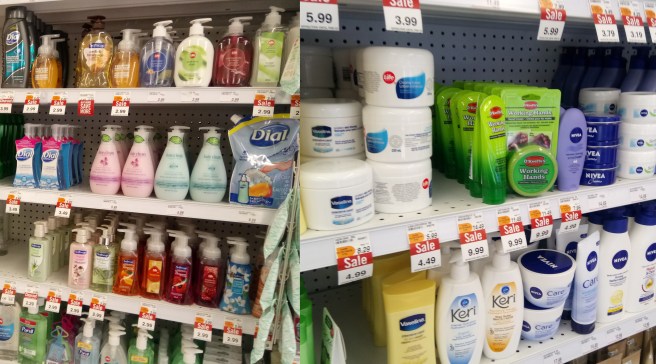
At my local Shoppers Drugmart: look at all these chemical and chemically preserved products! Don’t get me wrong, I still use them sometimes…but if I had a natural alternative, probably not.

I think as a society, the culture is moving away from chemical dependencies as a whole in general. I do feel that people prefer food that hasn’t touched pesticides, and are organically grown without fertilizers…Society seems to want more natural things in bodies, so why not reflect this view when it comes to cosmetics, if possible? Don’t get me wrong I like my chemical stuffs too, I use at least a dozen different chemical make-ups everyday; I wrote an article singing the praises for a superstay lipcolour formula that has the lasting power of car paint enamel! But when I can, I readily choose natural: I remove make-up with coconut oil. I use olive oil to amp up my hair conditioner…Vitamin E capsules used externally for my face at night, sugar face scrub, glycerin setting spray…anything that is food for internal can be also be food for skin or hair…

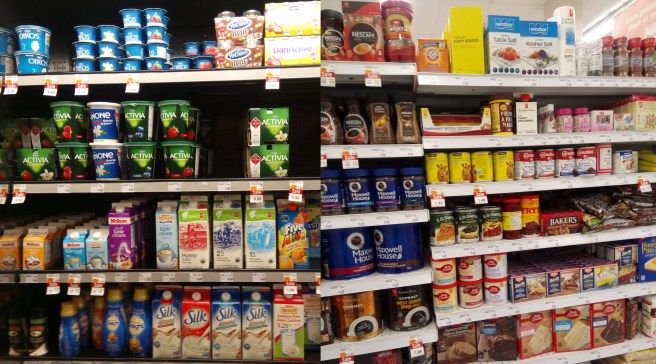
So here is the food isle at my local drugmart: I have been known to use many food grade items for cosmetic purposes: sugar, honey, yogurt, olive oil, coconut oil, cornstartch…etc. just to name a few…

In the end, I don’t think food grade ingredients at their purest, simplest form can ever be harmful. Think about in the past, before industrialization…people had to resort to what was around them to take care of their skin. Shea butter from the shea nut…is still used for cooking and moisturizing skin in many places of the world, with amazing healthy results…nut shells for exfoliation…cocoa butter, aloe vera…all of these plants derived food ingredients are still widely used on the body externally…and there is no scientific study or test needed to formulate and manufacture then truth that they work well. It just makes sense they do because sometimes Nature knows more about beauty, than chemical Science does.

Doing your own nails…why it’s better…

I’ve had a long relationship with doing my own nails. Ever since I was a teenager, searching for the trendiest colours, whether it be gun metal black, or a candy inspired pastel-y blue; it’s been something that as a nail art enthusiast, I’ve known all about. As a teenager, I didn’t really have the cash or the need to go to a salon to get my nails done…and as much as the thrill of getting pampered is these days now that I’m older with a ton more on my plate…one thing still stands; I want to do my own nails. Ā I prefer to shape, paint and design my own nails…and here’s why…

Reasons to do DIY manicures:

  1. It’s easy to do. There is a misconception that a manicurist can do it better than you. Well, maybe they are better at painting within the lines, but ultimately, all you need is: a base coat, two colour coats and a top coat. The real trick is keeping all the coats thin so they dry relatively fast…(a cool tip for setting the polish real quick? Rub each nail with coconut/olive oil for a minute after the final coat to help it set)
  2. The myth that a manicurist shapes better…this is not true. Invest in some basic nail files, coarse for shaping and fine for smoothing, and you’ll get the loveliest shapes with your nails. My go to shape? An almond shape…short on the sides and softly arced on the tips.
  3. The misconception that the quality of the polish is better: there is so much noise out there today about gel nails, seaweed nails, and all this stuff. But when it boils down to it, the salons are using the same paints that you can buy at any quality beauty supply shop.
  4. Health reasons: you can choose to buy and use formaldehyde free polishes, “three free”, and “seven free”…basically, you can get gentler products that contain less toxins in them if you really wanted to and you should for the sake of you and your nail health.
  5. Think of the health and ethical rights of manicurists/beauty workers. I recently read this scary article about how in New York City, manicures are so cheap, like less than $10 a pop, and the reason for that is not pretty: a lot of the salon workers are immigrants that don’t get paid well, and are exploited in terrible work conditions. Ā Not only that, but they are exposed to really toxic nail enamel solvents and chemicals and it affects the worker’s health (even their unborn babies if they are pregnant!) Ā I also feel like it places a big divide between more fortunate women and less fortunate ones…At the end of the day we are all people, so don’t support these back-alley nail salons. Ā At least go to a higher end salon that is known to treat their workers right and pay adequately for the luxury of being pampered.
Have fun with designing and creating colour combinations…I always do!

So there it is, my 5 main reasons why it’s better to DIY your manicures. Ā Yes, it takes more time and effort to do your own nails, but at the end of the day, they are your nails and if you want them to glow and shine…it is a creative job that should not be “outsourced”. Ā šŸ™‚