Are there rules to Make Up after 40?

I have passed by countless articles and videos on social media over the past few years about how wearing and applying make-up is different for aging faces. And I never paid much attention to them, always skimming the feeds and skipping the links. The main reason is that I have just looked very youthful for most of my adulthood and did not feel the tips applied to me. My vanity and confidence in my youthful appearance would not let me entertain the idea that I maybe needed these tips…it’s not for me, I always told myself. But here I am, thinking more about it more recently. I now do see fine lines appearing, and places on my face that are a bit saggy. So what are these make up tips/rules now that I can see changes? I want to write down some of my own tips that I believe are ageless good practice, fand have nothing to do with being “over 40”.

Truth is, I don’t believe age should affect make-up application, colours or techniques, that’s too broad of a generalization. I think that changes in make up application is more personal and should be tailored. As a society that is pushing more forward with gender inclusivity, political and social awareness, the place that I feel is still left behind is the stigma with aging female bodies. Society assumes certain things about someone of a certain age. Older women especially seem to get pigeon holed into categories that are age biased and unpleasant, A “hag”, a “cougar”, “grandma”, “milf”, “pre-menopausal”…etc. Even the well meaning “mature” lady is kind of well, sucky. As one ages, skin texture does change, but instead of calling it aging skin or “over 40 skin”, it should be recognized as just a change in texture.

My Makeup Tips for Skin with fine lines and less plumpness:

  • Moisture is everything: Fine lines are actually accentuated by dry skin. Be sure to hydrate internally (drink lots of water) but also externally. Antioxidants like vitamin E oil does double duty, it hydrates and increases the suppleness of skin on an outer level. It also promotes healing from sun damage or pollution in the air.
  • Sunscreen should be in the makeup or under the makeup. Science doesn’t lie. UV rays in the sun does cause aging of the skin, dryness and fine lines.
  • Be careful with cosmetic powders. I love a pretty eye shadow colour, and setting powders to make make up last. But powders also absorb moisture and is drying in that sense. I now opt for cream eye shadows, and cream blush. And only use a light dusting of face powder over my foundation. We want a bit of shine and glow as we age, since powdery and cakey make the skin look like it is dry and wrinkly.
  • Exfoliate often: cell turn over rate slows down over the years. Help out the face by using gentle exfoliants to keep skin soft and diffuse any fine lines that may want to show up on dead skin. I like to use a lactic acid exfoliator. Super gentle.
  • Metallic shimmer is pretty, but it’s light reflecting ablity can settle into fine lines and highlight what is not smooth. Choose makeup colours that are matte or pearlescent. Much more flattering.
  • No harsh lines: eyeliner should be super soft and blended, with the exception of liquid liner to get a bold cat eye line. Otherwise, pencil liners should be diffused with a blending tool for softness. Add to the softness by opting for a charcoal grey pencil colour instead of jet black!
Mimimal powder and cream blush and cream eyeshadow. Blended eyeliner. It makes all the difference I feel these days to flatter my changing skin.

These are my tips for the small changes I see in my skin and how make-up might be adapted to better suit me. But everyone is different! I have talked to people whose faces actually get oilier as they get older and in that sense would have a different set of tips for make up. At the end of the day, just stay beautiful and take the best care of oneself possible. Be thoughtful and willing to change routines and rituals.
Some basic, but important Tips for Make-up Beginners

First: A Throwback of my Past Make-up How-to’s:

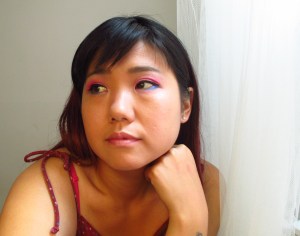
I write a lot of articles about different make-up looks, whether it be a natural or vampy look, or valentines’ day flirty eyes; I have fun expressing unique make-up applications. Here a few of my escapades with make-up and color:

This is from my article on how to do be-witching eye make-up! check it out here.

Very dark lined cat eyes for a fashion forward winter holiday look. Article here:

An 80’s electric eyeshadow look for a bold statement. Article here

What works for New Make-up Wearers?

My make-up looks are certainly fun if you want to change up your daily routine, but what about people who want to start wearing make-up and are intimidated by all the complicated/trendy tutorial out there? I think the best make-up looks enhance your facial features simply, and doesn’t change or hide them. Like making your eyes look brighter with a shiny shadow, or making your skin creamier with a bb cream… In essence, make-up is basically playing up what you have naturally, and it shouldn’t feel odd or awkward. It’s a fun form of self expression, and one of my favorite ways to show off. Here are some basic suggestions I want to give beginners who are starting to wear make-up.

Tip # 1: No substitute for Good skin

Before putting on make-up, one needs to take care of the skin. Cleanse, exfoliate, moisturize, and use an antioxidant nightly on your skin. When you have healthy skin, make-up can actually do it’s job properly. Check out my line of natural skincare to learn more.

Tip # 2: Use an SPF or SPF loaded foundation

The sun is not your friend.  UV rays and ultra violet light from the sun IS what causes premature aging and wrinkling, so wear a sun screen under the make-up. If that is too heavy of a base, find a foundation with higher than 15 SPF to help protect your skin from harmful rays at the same time as giving you coverage.

Step 3: Level of coverage in Foundation:

Be honest about the level of coverage you want.  There are three levels of coverage: Light coverage is a tinted moisturizer, with no powder, medium is a light foundation/bb set with a bit of powder, and full coverage is a heavy foundation and concealer set with powder. I tend to like a medium coverage for day to day, since that often means I can skip concealer for minor uneven tones. But if you want the flawless skin look, you will have to go for full coverage. All options are fine, but choose the one that you want, not the one that you think you should want. Just because you have been make-up shy all your life doesn’t mean you can’t have the flawless full coverage look. Be willing to experiment to find what works for you!

Step 4: Definition of the face:

Using a foundation will mute all your other features. Your eyes will look smaller after foundation application, your mouth will be colorless, your eyebrows non existent. Your cheeks without color. So this is the time to add back definition.The more products you use, the more defined your features become. My minimum staples for definition are eyebrow color, eye lid color, mascara and blush. If you want extra definition, you can add an eyeliner, liquid or pencil, contouring/bronzer, lipstick, false lashes…etc. But again be honest with the level of definition you want!

The Bottom Line:

I feel that when starting to wear make-up for beautifying effects, it’s really important to be honest with yourself and how much coverage/definition you want to present to the world. Take the time to figure out what level of “made-up you really want”. And just like when wearing fashion, you want to have fun while expressing yourself with your make-up looks! Having a positive attitude and a willingness to try new things will get you farther in anything, any day!

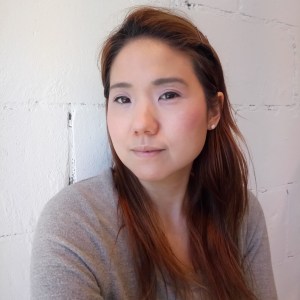
My day to day make-up look. Very minimal: Medium coverage foundation with a light powder, eyebrow definition, thin lined top lid and neutral eye shadows…no lipstick, but a bit of blush! My go to natural look…

Why the hesitation to use natural/food grade ingredients in cosmetics?

I never really thought of this before. It’s kind of logical to me. In a battle of best cosmetic ingredients between natural and chemical, natural is just better. If I can eat something, like coconut oil, and then also use it on my hair to moisturize, that’s a win win situation…I have always thought that if it is safe to go into our bodies, it is safe to put on our bodies…but I recently found out not everyone thinks this way…There is a point of view that cosmetics should remain a chemical science, and that putting food on ourselves is just well, kinda dirty. Where did I get this idea from? A man working at a hair supply shop told me this, when I mentioned I used a bit of coconut oil for my dry ends. He said the problem with food grade is that it mixes with microbes and such on our bodies and can easily become rancid and/dirty.

Hmm…Dirty? I never realized this point of view before, and while I think the shop guy might be right to some degree, I still think it’s an exaggeration at best. The outsides of our bodies can take a bit of dirt and microbes. Our own bodily oils are teaming with loads of bacteria and such, it’s all over us…adding food grade ingredients does not necessarily add to the microbial community…maybe it would if we never showered…but the average person in North America probably showers at least once a day; not enough time for coconut oil or any food grade oil to become rancid, and thus dangerous to our health. Advocating for chemicals and chemical preservatives to remain the standard for quality hair care, is a bit unfounded. Many of the chemicals in cosmetics are known to be drying, irritating to the skin, cause allergic reactions, and even have traces amounts of carcinogens. Yikes.

The trend to go natural is so strong actually, that many big cosmo companies now say they have squeezed natural ingredients into their formula. I’ve seen so many times the advertising and labeling of big brand products claiming to use honey, botanicals, fruits, natural oils and butters. The ironic thing is the natural inclusions are often very denatured/altered and it’s a very minute amount that’s used. Why moisturize with a vat of silicones and trace amounts of cocoa butter, if cocoa butter is the actual desirable ingredient? I have to toot my own horn when I say I make a solid lotion at Dream E that is a third made of cocoa butter and all natural other ingredients, except for a small amount of fragrances. But 95% natural is better than 1% natural any day in my opinion.

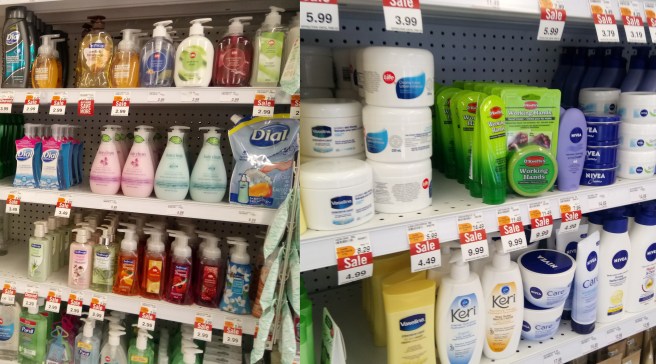
At my local Shoppers Drugmart: look at all these chemical and chemically preserved products! Don’t get me wrong, I still use them sometimes…but if I had a natural alternative, probably not.

I think as a society, the culture is moving away from chemical dependencies as a whole in general. I do feel that people prefer food that hasn’t touched pesticides, and are organically grown without fertilizers…Society seems to want more natural things in bodies, so why not reflect this view when it comes to cosmetics, if possible? Don’t get me wrong I like my chemical stuffs too, I use at least a dozen different chemical make-ups everyday; I wrote an article singing the praises for a superstay lipcolour formula that has the lasting power of car paint enamel! But when I can, I readily choose natural: I remove make-up with coconut oil. I use olive oil to amp up my hair conditioner…Vitamin E capsules used externally for my face at night, sugar face scrub, glycerin setting spray…anything that is food for internal can be also be food for skin or hair…

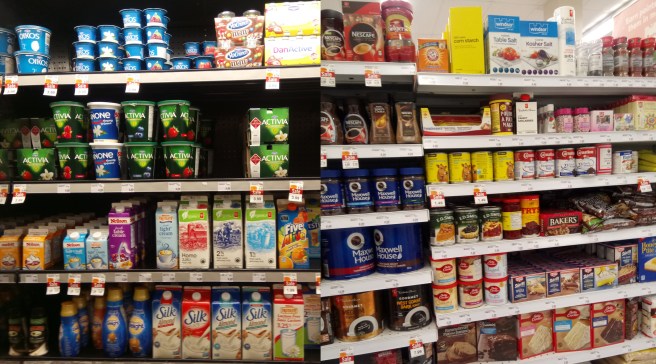
So here is the food isle at my local drugmart: I have been known to use many food grade items for cosmetic purposes: sugar, honey, yogurt, olive oil, coconut oil, cornstartch…etc. just to name a few…

In the end, I don’t think food grade ingredients at their purest, simplest form can ever be harmful. Think about in the past, before industrialization…people had to resort to what was around them to take care of their skin. Shea butter from the shea nut…is still used for cooking and moisturizing skin in many places of the world, with amazing healthy results…nut shells for exfoliation…cocoa butter, aloe vera…all of these plants derived food ingredients are still widely used on the body externally…and there is no scientific study or test needed to formulate and manufacture then truth that they work well. It just makes sense they do because sometimes Nature knows more about beauty, than chemical Science does.