Yes! There is more work in Haircare for Coloured Hair…

I’ve been wanting to talk about how often I have heard this reason people use for not coloring their hair: It’s often because in the past the hair colour (especially lightening) had “wrecked” their hair health and it didn’t look good the subsequent weeks after the process….and I have only one thing to say to that. That’s not really a reason not to colour! Lightening and colouring hair doesn’t have to be inherently damaging. Coloured hair does however require more work, time and cost to maintain it’s health afterwards. It’s the sentiment that anything that’s worth having takes WORK. It’s like how committing to a more streamlined body may require more hours at the gym, wherein the goal for exercise is no longer about health–it’s about achieving or maintaining a look. It’s about being willing to put in extra effort to get the look we want! As a hairdresser I know about the high cost of maintenance so I agree that for some, it’s sometimes not worth it. But for that practical reason, it’s a “different song and dance”.

This is my hair colour when it’s not styled. But even so. a lot goes into this look including not washing it often, leave in treatments, oils…etc.

The Hurdles of Hair Colour And After-Care:

  1. Retouches: Hair grows…the last I checked, so that means after two months about an inch of regrowth is expected. While the natural hair color is okay on it’s own, the line that happens when the new growth meets existing artificial colour is usually not flattering. Here’s where maintenance is required. Refreshing the roots of the hair is a must and the most that a root smudge can do is prolong the need for refreshing.
  2. Re-toning: Even if a root retouch is not necessary, sometimes toning is. Artificial colour is not really permanent, even if it says it is. After exposure to shampoos and the sun, the hair colour will fade, leaving behind the brassiness that was previously covered up. Re-toning is often a procedure for blondes and cool toned brunettes when the colour fades.
  3. Excessive Dryness: because the cuticle of the hair needs to be lifted to be coloured, it never lies as flat as it did before dying. That means the hair strand’s ability to hold onto moisture will be compromised. Heavy conditioners with moisturizing properties must be utilize to maintain shine and mitigate frizz! Leave-ins and oils too!
  4. Weaker hair prone to breakage: Colouring hair depletes some of the proteins/keratins in the hair strand making it more prone to breakage. Keratin repair masks will be needed occasionally to help strengthen the hair and prevent breakage. This is especially true for blondes that were lifted starting from very dark bases.
  5. Change in haircare routines: Because coloured hair tends to be more fragile, it often benefits from less washing and styling. Shampooing lowers the natural pH in the hair and does cause it physical stress. We love the feeling of squeaky clean hair but seeking that too frequently comes at as cost. A new routine of less washing and more leave in conditioners and oils become the daily norm!
  6. Extra styling: Wash and go. That’s a term we all love! It means after shampooing and conditioning, little styling or products are needed. Air drying, and just a quick rough tumble under the hair dryer at most. But often after colouring, hair needs more styling to get the hair looking less frizzy; extra products and heat tools like a flat iron might be needed to make the hair look smooth!

Is this too much work and maintenance for having a different hair colour? But that is the true cost of hair colour…in the end, I guess it is to each their own. But that’s the reality of anything done for cosmetic reasons. It takes work. But doesn’t mean we shouldn’t do it! For me, hair is like a canvas for expression, but as an extension of our bodies, it is also more than that.
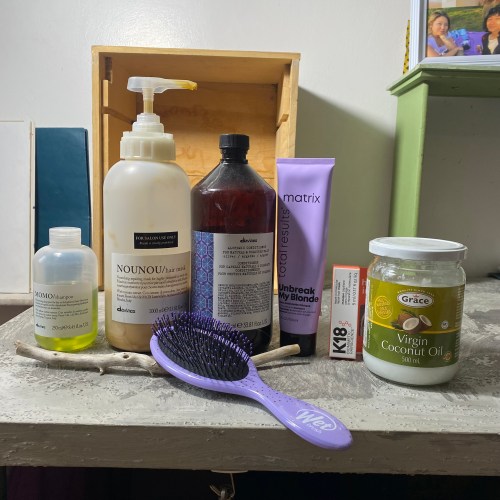
This is the heavy line up of arsenals I use for my blonde care! A gentle shampoo, moisture mask, purple toning conditioner, anti breakage leave in, K18 treatment, coconut oil, and a wet brush to name a few!!!!

How to make use of old perfumes and scents!

This is my current mish mash of scents that I relocated to another bottle!

I went through a troubling break up earlier this year. One that was so difficult it caused me to lose some of my hair, question my ability to deserve a long-term fulfilling relationship and distract me from what matters the most: How to be a happy person. It’s not about who I’m with. Who I am with doesn’t give identity, elegance or a sense of feeling whole. These things are found emotionally within and manifested externally. They are the things that give strength and enable us to be useful and helpful to those we care about. Together with all of my own aesthetic experiences and now that I practice working professionally in the beauty industry as a hair stylist…one thing is constant. It has to come from within first. We have to feel beautiful inside first, before we can manifest this beauty outwards. There has to be a sense of wellness. There has to be respect for our time, bodies and minds first. I feel that you can seek advice from any professional, but to be honest, it all begins with how we view ourselves.

What does my ramble have to do with perfumes and scents? I wonder this myself as I write this. I am saying that we all have that pile of cosmetics that we bought on impulse, thinking they would make us happy, but for some reason, the pile sits as a rarely used collection of dusty intentions. Wanting to feel sexy or pretty or fun has made us buy these things: the beauty industry is guilty of ramming products down our throats. Business and marketing makes us buy it, but that’s not how these cosmetics work…technically it all starts with a connection to ourselves. Even the most beautiful people in the world have had adversities to overcome; failed relationships, cheating partners, addictions and been flawed in the most human way. But it’s about how we over come obstacles that make us unique and beautiful. In that way the dusty perfume collection can be seen as some of the ways we tried to escape our troubles, and soothe ourselves.

Instead of buying new scents to feel beautiful, make a “Frankenstein” scent. Gather unused, uninspired scents and mix them all together into an empty spray bottle! The singular scents that I thought I liked, but later stopped wearing can now have new life breathed into them by mixing them all together! Most perfumes have the same alcohol base. That means different scents can be combined and blended seamlessly. There is no recipe or order. Only that most perfume bottles can’t be uncapped. So it may mean tediously filing another bottle spray by spray by spritzing it in! But it’s worth it to not waste the leftover scents! Blending them all together will make something that smells amazing. Like a rebirth, lifting us from the ashes of our mistakes. It’s a renewal on the smallest most simplest level just by spritzing it on and donning a smile.

This is the spray bottle I’m using. I suggest using a glass one for perfumes, but a small plastic one will do! I will probably decorate mine by putting in small crystals!
From my many years of wearing and blending perfumes, I believe I learned that historically, perfumes and a lot of modern day cosmetics originated in Ancient Egypt! And so did cats! This is Shady.

Are there rules to Make Up after 40?

I have passed by countless articles and videos on social media over the past few years about how wearing and applying make-up is different for aging faces. And I never paid much attention to them, always skimming the feeds and skipping the links. The main reason is that I have just looked very youthful for most of my adulthood and did not feel the tips applied to me. My vanity and confidence in my youthful appearance would not let me entertain the idea that I maybe needed these tips…it’s not for me, I always told myself. But here I am, thinking more about it more recently. I now do see fine lines appearing, and places on my face that are a bit saggy. So what are these make up tips/rules now that I can see changes? I want to write down some of my own tips that I believe are ageless good practice, fand have nothing to do with being “over 40”.

Truth is, I don’t believe age should affect make-up application, colours or techniques, that’s too broad of a generalization. I think that changes in make up application is more personal and should be tailored. As a society that is pushing more forward with gender inclusivity, political and social awareness, the place that I feel is still left behind is the stigma with aging female bodies. Society assumes certain things about someone of a certain age. Older women especially seem to get pigeon holed into categories that are age biased and unpleasant, A “hag”, a “cougar”, “grandma”, “milf”, “pre-menopausal”…etc. Even the well meaning “mature” lady is kind of well, sucky. As one ages, skin texture does change, but instead of calling it aging skin or “over 40 skin”, it should be recognized as just a change in texture.

My Makeup Tips for Skin with fine lines and less plumpness:

  • Moisture is everything: Fine lines are actually accentuated by dry skin. Be sure to hydrate internally (drink lots of water) but also externally. Antioxidants like vitamin E oil does double duty, it hydrates and increases the suppleness of skin on an outer level. It also promotes healing from sun damage or pollution in the air.
  • Sunscreen should be in the makeup or under the makeup. Science doesn’t lie. UV rays in the sun does cause aging of the skin, dryness and fine lines.
  • Be careful with cosmetic powders. I love a pretty eye shadow colour, and setting powders to make make up last. But powders also absorb moisture and is drying in that sense. I now opt for cream eye shadows, and cream blush. And only use a light dusting of face powder over my foundation. We want a bit of shine and glow as we age, since powdery and cakey make the skin look like it is dry and wrinkly.
  • Exfoliate often: cell turn over rate slows down over the years. Help out the face by using gentle exfoliants to keep skin soft and diffuse any fine lines that may want to show up on dead skin. I like to use a lactic acid exfoliator. Super gentle.
  • Metallic shimmer is pretty, but it’s light reflecting ablity can settle into fine lines and highlight what is not smooth. Choose makeup colours that are matte or pearlescent. Much more flattering.
  • No harsh lines: eyeliner should be super soft and blended, with the exception of liquid liner to get a bold cat eye line. Otherwise, pencil liners should be diffused with a blending tool for softness. Add to the softness by opting for a charcoal grey pencil colour instead of jet black!
Mimimal powder and cream blush and cream eyeshadow. Blended eyeliner. It makes all the difference I feel these days to flatter my changing skin.

These are my tips for the small changes I see in my skin and how make-up might be adapted to better suit me. But everyone is different! I have talked to people whose faces actually get oilier as they get older and in that sense would have a different set of tips for make up. At the end of the day, just stay beautiful and take the best care of oneself possible. Be thoughtful and willing to change routines and rituals.