Does your hair need Hydrolyzed Protein…?

I’ve always struggled with hydrating my dry hair, because it always seems to be dry and stringy…and although it is long, it is often feeling weighed down by more than it’s own weight. I have always used my coconut oil hair salve daily and it has helped hydrate my hair to shine, de-tangling and smooth, but over use of a good thing can be bad too. Over moisturized hair from oils can leave hair feeling greasy, thin and rough. Hair color doesn’t shine as much, even if it is a fresh dye job when too much of an oil/silicone coating has taken over. But is there another way to add softness and hair vitality? I recently discovered that an ingredient called hydrolyzed protein (wheat, oat, silk, keratin) can do wonders for dull rough hair in ways that oil hydration alone can’t. Hydrolyzed protein fills in some of the gaps and roughness in your hair with an organic material that will feel kinda like new hair…when paired with a hydrating routine of conditioners/oils it’s a complete package of shine and softness.

Notice how stringy my ends are and how they seem to thin out near the bottom? They are moisturized, but not soft for some reason…it’s missing protein…
This is when I was lightening and coloring my hair a lot, and the chemical dyes saturated the shaft, but since it was missing protein, it’s not shiny, but rough in texture…

How did I find this out? While traveling during March Break and visiting Halifax in Nova Scotia, Canada, I stayed at a hotel there with spa quality toiletries. I tried their shampoo and instantly I felt a difference in my hair vitality; my hair was less wiry when damp, and the next day the strands felt plumper, reminding me of how it had been in my younger days. I knew it was not my conditioner that provoked the change since I had packed that from Toronto. It was the hotel’s shampoo. I then scoured the ingredient list on the hotel shampoo and found out the main ingredient that I didn’t have in my shampoo at home was hydrolyzed wheat protein. An ingredient that would prove to make the difference.

Havin’ a “good hair day” in this vacation photo from Halifax at the Nautical Museum. After using the hotel’s shampoo the night before, it felt softer, silkier than before. Can you see this in the photo?

Back in Toronto now and using a shampoo with a hydrolyzed wheat protein. And am really liking it. But I only have protein in my shampoo, since I hear that using too much protein can cause hair to be brittle! Everything in moderation it seems!  My main tip for true hair health though is to rely less on hair care products and just treat your hair well. Do you really need to have the unicorn hair color that requires bleaching it to white, or do you need your hair to be heat styled all the time? There is no ingredient, chemical or natural that can reverse hair damage. New fangled and expensive heal-all chemicals such as Olaplex have drawbacks too, as the beauty industry has discovered (although I won’t go into detail about it this time around). Bottom line: no product or oil can substitute minimizing hair damage in the first place, so treat your hair and body well.
Why the hesitation to use natural/food grade ingredients in cosmetics?

I never really thought of this before. It’s kind of logical to me. In a battle of best cosmetic ingredients between natural and chemical, natural is just better. If I can eat something, like coconut oil, and then also use it on my hair to moisturize, that’s a win win situation…I have always thought that if it is safe to go into our bodies, it is safe to put on our bodies…but I recently found out not everyone thinks this way…There is a point of view that cosmetics should remain a chemical science, and that putting food on ourselves is just well, kinda dirty. Where did I get this idea from? A man working at a hair supply shop told me this, when I mentioned I used a bit of coconut oil for my dry ends. He said the problem with food grade is that it mixes with microbes and such on our bodies and can easily become rancid and/dirty.

Hmm…Dirty? I never realized this point of view before, and while I think the shop guy might be right to some degree, I still think it’s an exaggeration at best. The outsides of our bodies can take a bit of dirt and microbes. Our own bodily oils are teaming with loads of bacteria and such, it’s all over us…adding food grade ingredients does not necessarily add to the microbial community…maybe it would if we never showered…but the average person in North America probably showers at least once a day; not enough time for coconut oil or any food grade oil to become rancid, and thus dangerous to our health. Advocating for chemicals and chemical preservatives to remain the standard for quality hair care, is a bit unfounded. Many of the chemicals in cosmetics are known to be drying, irritating to the skin, cause allergic reactions, and even have traces amounts of carcinogens. Yikes.

The trend to go natural is so strong actually, that many big cosmo companies now say they have squeezed natural ingredients into their formula. I’ve seen so many times the advertising and labeling of big brand products claiming to use honey, botanicals, fruits, natural oils and butters. The ironic thing is the natural inclusions are often very denatured/altered and it’s a very minute amount that’s used. Why moisturize with a vat of silicones and trace amounts of cocoa butter, if cocoa butter is the actual desirable ingredient? I have to toot my own horn when I say I make a solid lotion at Dream E that is a third made of cocoa butter and all natural other ingredients, except for a small amount of fragrances. But 95% natural is better than 1% natural any day in my opinion.

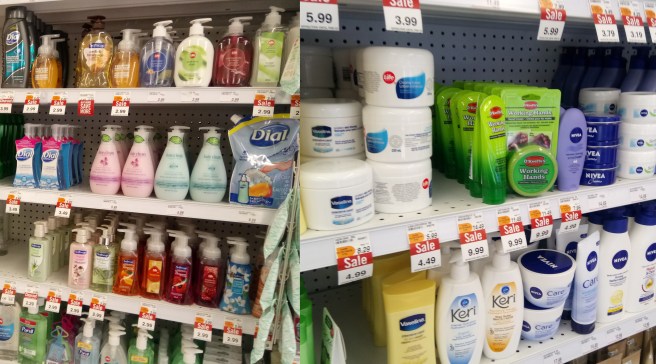
At my local Shoppers Drugmart: look at all these chemical and chemically preserved products! Don’t get me wrong, I still use them sometimes…but if I had a natural alternative, probably not.

I think as a society, the culture is moving away from chemical dependencies as a whole in general. I do feel that people prefer food that hasn’t touched pesticides, and are organically grown without fertilizers…Society seems to want more natural things in bodies, so why not reflect this view when it comes to cosmetics, if possible? Don’t get me wrong I like my chemical stuffs too, I use at least a dozen different chemical make-ups everyday; I wrote an article singing the praises for a superstay lipcolour formula that has the lasting power of car paint enamel! But when I can, I readily choose natural: I remove make-up with coconut oil. I use olive oil to amp up my hair conditioner…Vitamin E capsules used externally for my face at night, sugar face scrub, glycerin setting spray…anything that is food for internal can be also be food for skin or hair…

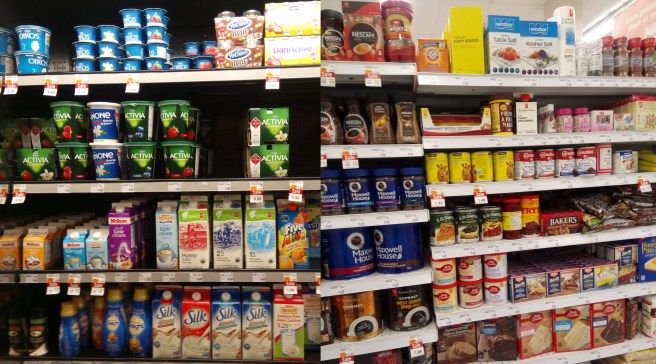
So here is the food isle at my local drugmart: I have been known to use many food grade items for cosmetic purposes: sugar, honey, yogurt, olive oil, coconut oil, cornstartch…etc. just to name a few…

In the end, I don’t think food grade ingredients at their purest, simplest form can ever be harmful. Think about in the past, before industrialization…people had to resort to what was around them to take care of their skin. Shea butter from the shea nut…is still used for cooking and moisturizing skin in many places of the world, with amazing healthy results…nut shells for exfoliation…cocoa butter, aloe vera…all of these plants derived food ingredients are still widely used on the body externally…and there is no scientific study or test needed to formulate and manufacture then truth that they work well. It just makes sense they do because sometimes Nature knows more about beauty, than chemical Science does.

Silicons in Hair Products, what do they really do?

On the left are products loaded with silicones...hey, they give the results, but are they evil?  On the right, silicone free products from Tresseme.
On the left are products loaded with silicones…hey, they give the results, but are they evil? On the right, silicone free products from Tresemme.

As you all know I craft handmade cosmetics on a regular basis to give my face and hair a rest from the chemical stuff that is out there at pharmacies today: hair spray, lotions, shampoo, conditioner–they all have preservatives, cheap synthetic additives and little to no healthful ingredients.  At home, I stock up on things like organic natural coconut oil, cocoa butter, shea butter and use it in all kinds of handmade natural products. But as much as I believe in the benefits of natural stuff, I know the limitations, cosmetically, of what natural products can do.  I also know that some synthetic ingredients such as silicons are often over vilified based on the fact that they are not naturally derived.

Silicones, the good news and the bad news…

The most common forms of silicone are dimethicone and cyclomethicone.  The actual ingredient name may vary from product to product, but you will see some form of “icone” at the end of the ingredient name if it is a silicone.  The higher it is on the list of ingredients, the more there is in the product.  Now to explain why it has a bad rep: It is a synthetic product that is derived from sand by chemical means and is very processed; its manufacturing and the washing of it into drains is bad for the environment.  When silicons are used in hair, it fills porous areas, giving only the “appearance” of healthier stronger, more hydrated hair.  But the actual effect is cosmetic.  Your hair is not really stronger, healthier or more hydrated.  It is shinier, and thicker because silicons coats each strand with a seal that is water resistant, oil resistant…and makes hair unable to breathe because of that seal. This is the good news: Hair is not alive, it doesn’t need to breathe. Hair is made up of an organic protein called keratin. A coating of silicone on the hair is not suffocating the hair, like I hear so many say, but it actually tames it and makes it shine like diamonds!  It becomes unhealthy when it builds up, and prevents natural oils from penetrating the inner hair shaft, making it dry and brittle.  Over use can turn a little beauty trick for softness and shine into a dependency for function.

Going au naturale…

I often hydrate my hair with coconut oil in salve form on dry hair and also as an additive in my conditioner to give it more conditioning power.  Coconut oil has been known to be able to penetrate into the hair shaft and really strengthen hair, not on just a cosmetic level.  But coconut oil also makes my hair limp, greasy, dragged down, and if it builds up, it takes away shine, actually.  But my hair is actually healthy, and hydrated, even if it looks dirty and unstyled.  I have been able to grow my hair longer these years by using coconut oil and just shampooing and heat styling less.  But boy did my hair love, love, love soaking up all the silicons in this hair conditioner I tried after coloring my hair the other week.  My hair was thicker, bouncier, fluffier, shinnier, and just more smooth feeling after using the silicone heavy conditioner included in the color kit.  I saw first hand how silicones are more powerful at giving an appearance of health than using natural products, even if it is a “fake” look of health, and I couldn’t believe how soft my hair was after using the silicon loaded conditioner.

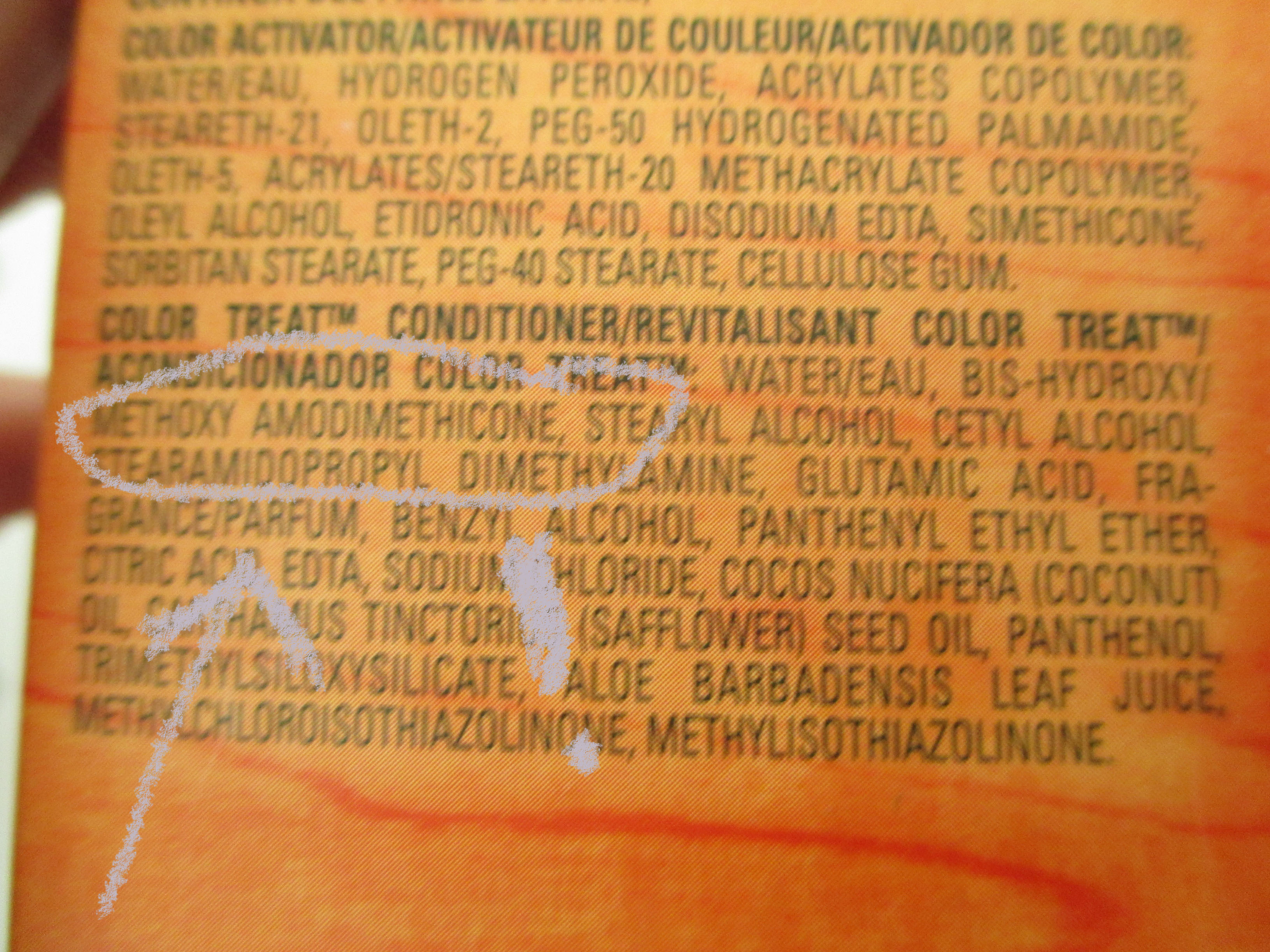
This was the ingredient list for the conditioner in the box kit.  Wow... amodimethicone is the second ingredient.  Amodimethicone is a heavy silicone, and hard to wash off...No wonder my hair shone like the sea after this...
This was the ingredient list for the conditioner in the box kit. Wow… amodimethicone is the second ingredient. Amodimethicone is a heavy silicone, and is hard to wash off…No wonder my hair shone like the sea after this…

So should we avoid or embrace silicones in hair products?

Silicones are not inherently bad, but if over used, they can cause your hair to form a dependency that is bad.  Also, their use and manufacturing causes damage to the environment, lakes and wildlife.  So perhaps the solution is to cut back and rely less on silicons to have healthy hair.  Get healthy hair it the hard and true way by not over heat styling or over chemically processing.  Condition hair with nutritious oils.  Also, avoid shampoos with silicones! Removing build up is key to hair health, so it baffles me why so many shampoos have silicones in them?!  It is like peeing in the tub, you’ll never get clean. Use hair conditioners with less amounts of silicone (lower on the ingredient listing) and/or only use silicones in finishing products as a means to cosmetically boost shine and maintain a style, as a last touch to give your hair the fake confidence it does need!

Shampoo is supposed to clean build up, right?  On my fave shampoo I found two silicone ingredients!  Not in my shampoo too!
Shampoo is supposed to clean build up, right? On my fave shampoo I found two silicone ingredients! Not in my shampoo too! I say, try to cut back.